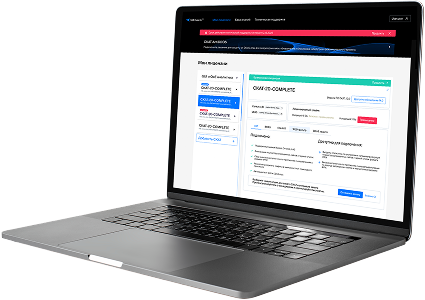
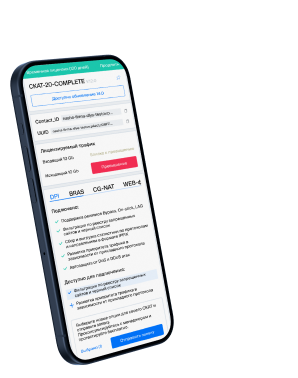
List of protocols
- Built-in protocols — updated along with the SSG software version. Installing a new version requires a DPI reboot, which causes traffic interruption.
If needed, they can be supplemented with up-to-date attributes from the VAS Cloud. This is only necessary for complex protocols, but the option is available for all. - Cloud protocols created by VAS Experts — are periodically updated from the VAS Cloud. This ensures that popular applications remain up-to-date as their behavior changes. Description
- Custom (user-defined) protocols — protocols created by users via the GUI using VAS Cloud tools. These have higher priority than those loaded from the VAS Cloud, and within them, IP:PORT takes precedence over IP and CIDR. It is possible to add a protocol based on IP, SNI, or AS. Guide.
- DSL protocols — protocols described in the DSL language and connected to DPI as a separate module, without reinstalling the software or causing traffic interruption. Unlike custom protocols, a DSL protocol is a finite state machine that analyzes the first N packets of a flow against defined conditions (ports, AS numbers, payload bytes, DSL expressions) and determines whether the flow matches the protocol.
DSL protocols are created by VAS Experts specialists upon client request to Technical Support.
| Protocol | ID | DPI version | Protocol group | Protocol type | Update | Description |
|---|---|---|---|---|---|---|
| PNNI | 65126 | 12.2 | Unknown | Built-in | As needed | pnni operates on port 65126 and supports Private Network-to-Network Interface for ATM network routing. |
| PIM | 65127 | 12.2 | Unknown | Built-in | As needed | pim operates on port 65127 and is used by Protocol Independent Multicast for multicast routing in IP networks. |
| ARIS | 65128 | 12.2 | Unknown | Built-in | As needed | ARIS protocol used in business process modeling or network management systems. |
| SCPS | 65129 | 12.2 | Unknown | Built-in | As needed | scps operates on port 65129 and supports Secure Copy Protocol Suite for file transfer in secure environments. |
| QNX | 65130 | 12.2 | Unknown | Built-in | As needed | qnx operates on port 65130 and facilitates QNX for real-time operating system networking services. |
| A/N | 65131 | 12.2 | Unknown | Built-in | As needed | a/n operates on port 65131 and refers to internal messaging or analytics network protocols with limited public documentation. |
| IPComp | 65132 | 12.2 | Unknown | Built-in | As needed | ipcomp operates on port 65132 and handles IP payload compression in IPComp-compatible VPNs or secure tunnels. |
| SNP | 65133 | 12.2 | Unknown | Built-in | As needed | snp operates on port 65133 and supports Simple Network Paging for lightweight network paging services. |
| Compaq-Peer | 65134 | 12.2 | Unknown | Built-in | As needed | compaq-peer operates on port 65134 and facilitates peer communication and service discovery for legacy Compaq systems. |
| IPX-in-IP | 65135 | 12.2 | Unknown | Built-in | As needed | ipx-in-ip operates on port 65135 and supports tunneling IPX packets over IP networks, used in legacy Novell environments. |
| VRRP | 65136 | 12.2 | Unknown | Built-in | As needed | vrrp uses port 65136. No additional documentation found. |
| PGM | 65137 | 12.2 | Unknown | Built-in | As needed | pgm operates on port 65137 and facilitates Pragmatic General Multicast for reliable multicast data delivery. |
| 0-hop | 65138 | 12.2 | Unknown | Built-in | As needed | 0-hop could refer to local device discovery or zero-hop network optimization in edge computing. |
| DDX | 65140 | 12.2 | Unknown | Built-in | As needed | ddx operates on port 65140 and supports communication in distributed data exchange systems. |
| IATP | 65141 | 12.2 | Unknown | Built-in | As needed | iatp operates on port 65141 and refers to an internal or proprietary transaction protocol with secure data transfer features. |
| STP | 65142 | 12.2 | Unknown | Built-in | As needed | stp operates on port 65142 and refers to a proprietary or extended Spanning Tree Protocol used in network topology management. |
| SRP | 65143 | 12.2 | Unknown | Built-in | As needed | srp uses port 65143. No additional documentation found. |
| UTI | 65144 | 12.2 | Unknown | Built-in | As needed | uti operates on port 65144 and supports communication for Unified Transport Interface in secure or enterprise-level network environments. |
| SMP | 65145 | 12.2 | Unknown | Built-in | As needed | smp operates on port 65145 and facilitates Simple Management Protocol for lightweight network management tasks. |
| SM | 65146 | 12.2 | Unknown | Built-in | As needed | sm operates on port 65146 and supports session management services in private enterprise systems. |
Was this information helpful?